What you NEED to know about MENOPAUSE and CLIMATE
The climacteric is the period around the time of the menopause, defined as a woman's last menstrual period. This period can last from 10 years before to 10 years after the menopause.
The climacteric doesn't have to be a period of loss of functionality, productivity, vitality or femininity for women. Unfortunately, many still go through this phase inadequately, without doing what is necessary to keep themselves well. In these videos, I explain, based on more than 20 years' experience in medicine, what has worked to help women live better and get through this period of profound and significant change in the best possible way.
Who is this video for? I think every woman should watch it:
1 - Those who are yet to reach the climacteric period and want to increase their chances of experiencing it with fewer discomforts, symptoms, weaknesses and even illnesses.
2 - Those who are already climacteric, many of whom don't identify, know or appreciate their symptoms as they should.
What about the men?
3 - Men should also watch the video in order to better understand the climacteric period and thus offer greater understanding and support to women facing this phase, which can be quite challenging for them and, consequently, sometimes also for those closest to them.
MOST RECENT VIDEO ON THE SUBJECT:
MENOPAUSE and Climacteric - What you NEED to know
VIDEO 2 - The danger of EXCESSIVE use of hormones
MENOPAUSE and CLIMATERE – Quick Reference (Brainstorm)
⚠️ What you need to know most (in my opinion, based on the best available evidence and a great deal of practical experience):
✅ The vast majority of WOMEN will develop symptoms and face an increased risk of disease as they enter menopause. Much of this tends to improve (and many symptoms and diseases may even disappear) with optimized replacement of the “lost” hormones.
✅ Women go through a biological transition that is a natural part of their lives (which many end up experiencing as a true “curse”): the decline and eventual cessation of the ovaries’ reproductive function. This transition is marked by menopause: the last menstrual period.
✅ Why does a healthy woman menstruate during the reproductive phase of her life? Because every month she prepares for a pregnancy: when pregnancy does not occur, everything that has been prepared (especially the inner lining of the uterus) must be shed and replaced by new substances and structures in the next cycle. In other words, menstruation is this “shedding” and renewal that the body undergoes.
✅ Basically, the menstrual cycle is regulated by hormones produced primarily by the ovaries—especially estradiol and progesterone—in a cyclical pattern. But the ovaries also produce significant amounts of DHEA and testosterone, which are essential for vitality.
✅ When the ovaries cease to function properly, a woman can no longer have regular menstrual cycles, and thus she enters menopause, a biological milestone. When this happens, there is a dramatic drop in the levels of the four hormones mentioned above, particularly estradiol and progesterone.
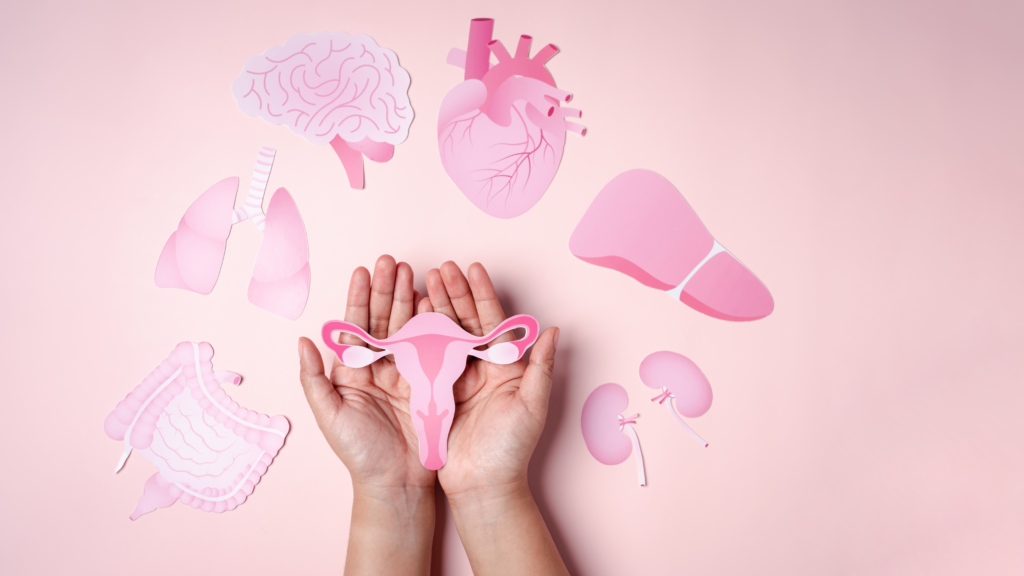
✅ The problem is that virtually the entire body has receptors for these hormones throughout a person’s entire life: the brain, heart, liver, bones, intestines, and immune organs.
✅ That is why, as hormone levels decline, it is most common for women already in perimenopause (the period leading up to menopause, when they still have irregular periods) to begin developing symptoms and conditions (or to see existing ones worsen). This deficiency greatly increases the risk of dementia (such as Alzheimer’s), stroke, heart attack, osteoporosis, and autoimmune disorders.
✅ It’s worth remembering that the ovaries don’t “shut down” all at once: hormonal declines begin well before menopause and already cause or exacerbate symptoms and conditions during the period of a woman’s life known as the climacteric. The climacteric begins when a woman experiences her first symptoms caused by declines in ovarian hormone production.
✅ That is why it is essential for every woman to understand that, as she ages, many of the health issues she develops could be prevented or better treated by restoring hormonal balance (preferably through bioidentical/isomolecular hormones), rather than merely “treated” (suppressed?) with allopathic medications. So much so that global guidelines on hormone therapy have recently been revised: what was once contraindicated is now recommended for the vast majority of women, following a detailed clinical evaluation and individualized testing.
✅ Always remember that the better a woman’s lifestyle habits, the better her overall health—and the less symptomatic her menopause tends to be. Hormones should only be used in conjunction with an impeccable lifestyle: I explain this in full—and for free—in this health guide at https://dominesuasaude.com.br/
✅ A summary of the story, based on extensive research and my experience over more than 25 years in medicine, during which I have treated and cared for thousands of women: When a woman improves her lifestyle habits and restores her hormonal balance, she will OFTEN avoid suffering and stop taking medications that are either unnecessary or prescribed too hastily. There are exceptions, but you need to be well-informed about your options, don’t you think?
If this post helped you, please share it. And hopefully it will reach all women!
Please feel free to leave a comment or ask a question.
To find out even more about the fundamental aspects of women's health, go here:










 Português do Brasil
  English